
Lightweight 5th Wheel Toy Hauler Guide for Utah Buyers

You're standing at the ramp with a tape measure, looking at a side-by-side that fits with room to spare, and the spec sheet says the trailer is light enough for your truck. That's exactly where most Utah buyers get tripped up. The machines fit, the dry weight looks fine, and nobody's yet added water, fuel, tools, passengers, or the hitch itself.
A lightweight 5th wheel toy hauler can be a smart buy for trips to Jordanelle, Bear Lake, or the trails beyond Spanish Fork. It just won't tow well on good intentions. What matters is the loaded, road-ready weight, the pin load on your truck, and whether the cargo allowance survives your real gear list. Those numbers decide the purchase, not the brochure weight.
Lightweight Toy Haulers and the Trade-Offs You Accept
A lighter trailer isn't automatically an easier trailer to tow. It can be easier on payload, braking, and maneuvering, but only if the loaded weight still fits the truck. A toy hauler that starts light and gets loaded heavy behaves like a heavy trailer on a Wasatch grade.
The layout explains why. A fifth-wheel toy hauler combines living quarters up front with a rear cargo garage for motorcycles, ATVs, side-by-sides, or bicycles. That garage needs a stronger floor, a ramp, tie-downs, and room to secure machines, so it carries structural weight that a standard fifth wheel of similar length doesn't carry in the same way.
What Lightweight Usually Costs You
There's no single standardized weight class behind the word lightweight. Published comparisons show models spread across a broad dry-weight range, and two trailers sold under the same label can differ by thousands of pounds before you load anything. Treat the label as a starting point for questions, not as a rating.
Going lighter normally means accepting some combination of compromises:
- Smaller cargo allowance: Less room in the weight budget for machines, fuel, and water, even if the garage floor looks generous.
- Shorter garage layouts: A machine may fit lengthwise while leaving little space to walk around it, strap it down, or reach storage.
- Reduced water and storage capacity: Shorter trips are easier to manage than long dry-camping stays at altitude.
- Fewer amenities: Lighter cabinetry, smaller tanks, or simpler equipment may be part of how the weight came down.
- Greater sensitivity to loading position: Where a heavy machine sits matters more when your margins are tighter.
None of those trade-offs is a deal breaker by itself. A couple hauling two dirt bikes for weekends near the Great Salt Lake can accept compromises that a family hauling a side-by-side, tools, and a week's supplies to Bear Lake can't. The right question isn't whether you can live with less. It's which specific limits you'll hit first.
The Utah Reality Check
Mountain driving exposes weak math fast. Grades on the way to Jordanelle or Bear Lake demand braking margin, cooling capacity, and directional stability, and high-altitude camping often means carrying more water, fuel, and cold-weather gear than a valley weekend requires. Winter storage adds another layer, since a trailer packed and parked carelessly can hide tire, battery, and plumbing problems until spring.
A lightweight trailer should lower the demands on your truck. If your loading plan uses up every pound of margin, you haven't bought an easier tow. You've bought a tight one.
Be honest about your household size, your machines, and your routes before you compare floorplans. If you need maximum garage flexibility and long off-grid stays, a heavier hauler and a stronger truck may serve you better. If your loads are modest and your trips are short, a lighter model can work well, provided the numbers still close after loading.
Comparing GVWR, Dry Weight and Cargo Capacity
Two trailers can sit side by side on the lot, the shorter one looking like the easier tow, and still end up heavier once both are loaded for the weekend. The spec sheet explains why, but only if you read three lines together. Dry weight is the trailer as built, without your cargo, water, or trip supplies. GVWR, or gross vehicle weight rating, is the maximum the trailer is allowed to weigh loaded. Cargo-carrying capacity is the difference between the two, and it's the budget everything you add has to fit inside.
Shoppers often read those numbers in isolation. A low dry weight gets celebrated, a longer floorplan gets assumed to mean heavy, and cargo capacity gets treated as free space for toys. Read together, they tell a different story. Our guide to what dry weight actually means for Utah buyers breaks down where the factory figure stops and your real loading begins.
Published Lightweight Toy Hauler Specs Compared
A published comparison of the lightest fifth-wheel toy haulers listed the Dune Sport DW5SK 24 Foot at 6,460 pounds dry weight, 24 feet long, with a 10,400-pound GVWR and 3,940 pounds of cargo-carrying capacity, alongside the heavier examples in the table below.
| Model | Dry Weight (lb) | Length | Cargo Capacity (lb) |
|---|---|---|---|
| Dune Sport DW5SK 24 Foot | 6,460 | 24 ft | 3,940 |
| KZ Sportster 280TH | 8,100 | 32 ft 6 in | 3,400 |
| Forest River XLR Micro Boost 301XLRE | 8,348 | 32 ft 6 in | Not listed in the comparison |
| Sandstorm | 9,640 | Not listed in the comparison | 4,570 |
That same comparison placed other models between 8,702 and 10,218 pounds dry, a spread wide enough that dry weight alone tells you little about what any of them will weigh leaving your driveway.
How to Read the Gaps Between Models
The table rewards a second look. The shortest trailer, the Dune Sport, carries one of the larger cargo allowances relative to its size. The Sandstorm starts much heavier dry, yet offers more cargo room in absolute pounds. The KZ and Forest River share the same length but not the same dry weight, so length alone doesn't settle which one suits your truck.
What decides suitability is the loaded total against your truck's limits. A trailer with a modest dry weight and a large cargo allowance can still reach its full GVWR once you load it, and that's the condition your truck has to pull, carry on its rear axle, and stop on a downgrade. A trailer with a higher dry weight but cargo room you'll never use can end up towing at a similar loaded weight in practice.
Practical rule: Compare trailers at the weight you'll actually tow them, not at the weight they left the factory.
Write down all three numbers for every model you consider, then set them against what you expect to load. A trailer whose dry weight plus your estimate lands near GVWR has no room for surprises. One that lands well under leaves margin for water, passengers, and the gear people always forget.
Calculating Real Cargo Capacity for Powersports Gear
The garage can have empty floor space and still be overweight. That's the single most common misread we see in this category, and it happens because buyers test fit instead of testing weight. Physical space and cargo capacity are two completely different limits.
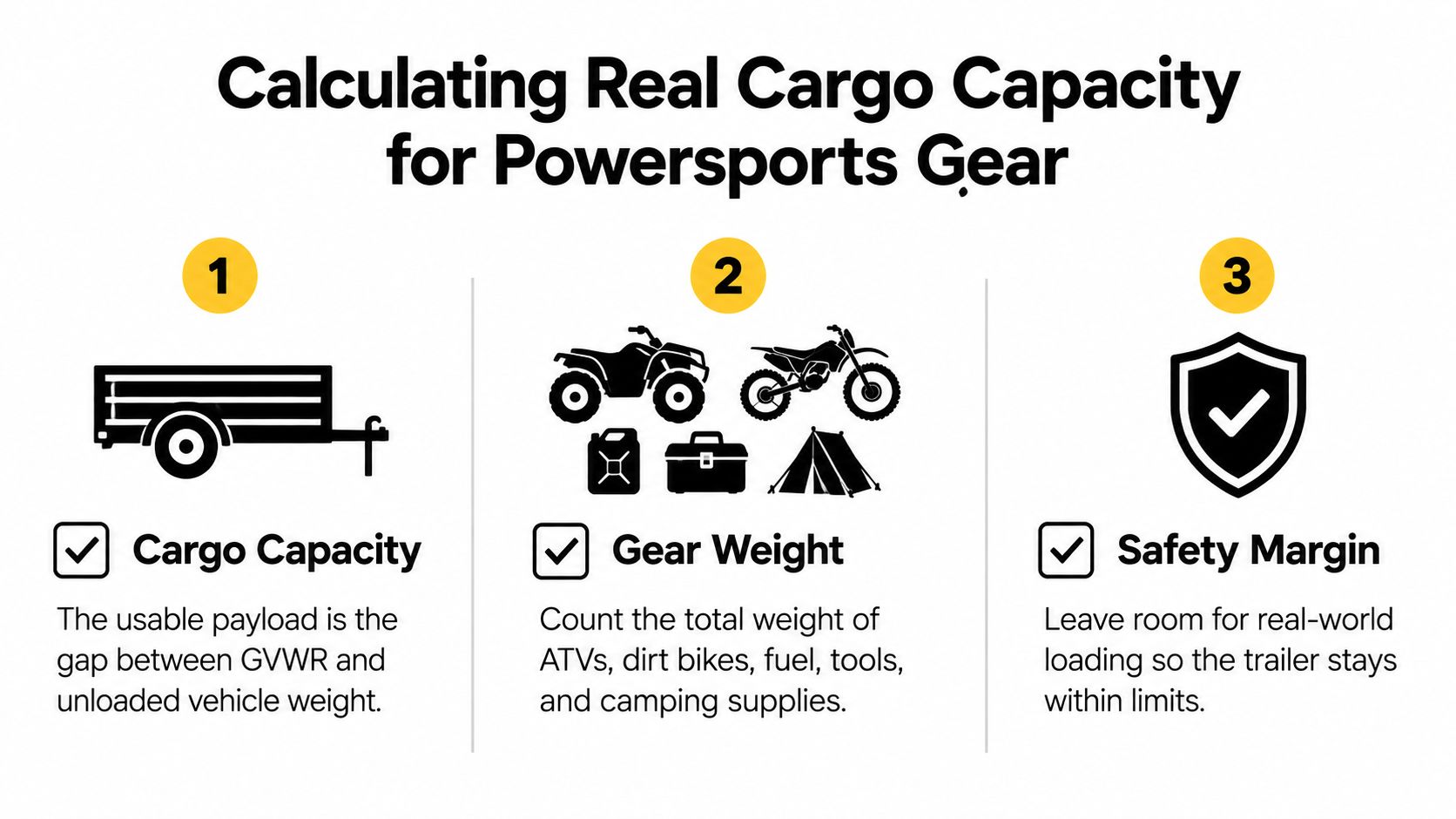
Cargo capacity isn't reserved for your machines. As RV guidance defining cargo-carrying capacity as GVWR minus unloaded vehicle weight explains, cargo-carrying capacity is the difference between a toy hauler's GVWR and its unloaded vehicle weight, and it must cover the toy, fuel, fresh water, propane, food, clothing, tools, batteries, and accessories added after the unloaded weight was established. Every one of those items draws from the same pool.
Build a Written Loading Estimate
Don't estimate from memory in the showroom. Make a list at home, weigh what you can, and be conservative with the rest:
- Each machine: Use its actual weight with fuel and accessories fitted, not a base-model figure.
- Loading equipment: Add ramps, tie-downs, wheel chocks, and spare parts.
- Fluids and fuel: Estimate fresh water, propane, and any extra fuel containers you'll carry.
- Batteries and power gear: Include batteries and anything added after delivery.
- Household cargo: Food, clothing, bedding, cookware, chairs, and recovery equipment.
- People gear: Helmets, riding gear, toolboxes, and coolers that ride in the trailer.
Motorcycles or side-by-sides can consume several hundred to several thousand pounds before passengers and camping supplies are loaded, so the machines set the shape of the whole budget. Add the list up and compare it with the stated cargo limit. If the total only fits by assuming empty water tanks and minimal food, it doesn't fit how you'll really travel.
Where Good Estimates Go Wrong
Buyers forget fluids most often. A trailer that works on paper with dry tanks may not work filled for a weekend without hookups near Bear Lake. Options installed after the unloaded weight was recorded also disappear from people's math, even though the trailer still has to carry them.
Bicycles create a related trap. Riders who move bikes outside the garage to save interior space still add weight to the combination, and it helps to think through towbar versus roof bike racks before assuming exterior storage is weight-free. Wherever the gear rides, the truck and trailer ratings still have to absorb it.
Keep the finished list with your trailer paperwork. When you add a machine, swap batteries, or start carrying more water, update the total. A written estimate you revisit beats a confident guess you made once at purchase.
Pin Weight and Payload Math for Your Tow Vehicle
Total trailer weight tells you what the truck pulls. Pin weight tells you what the truck carries, and for most fifth-wheel buyers it's the number that runs out first. You can be well under your tow rating and still be over payload.
The hitch sits over the rear axle, so a share of the trailer's loaded weight presses down into the truck bed. Manufacturer hitch guidance placing about 15% to 25% of loaded weight on the hitch states that approximately 15% to 25% of a fifth-wheel trailer's total loaded weight should rest on the hitch, so a toy hauler loaded to 12,000 pounds could place roughly 1,800 to 3,000 pounds on the truck's hitch. That load must fit inside the truck's payload rating.
Run the Calculation in Order
Work through it the same way every time:
- Estimate loaded trailer weight: Start with unloaded weight and add your written cargo estimate. Don't use dry weight as the finished number.
- Apply the pin range: Multiply the loaded estimate by the 15% to 25% range to get a realistic pin-weight band.
- Open the driver's door: Read the payload figure on the door-jamb sticker for your specific truck, not a brochure figure for the model line.
- Subtract everything else: Deduct passengers, fuel, bed cargo, tools, and the fifth-wheel hitch itself from that payload number.
- Compare what remains: If the leftover payload doesn't cover the upper end of your pin estimate, the combination is too tight.
Our overview of how maximum towing capacity differs from payload limits covers why the advertised tow rating misleads so many fifth-wheel shoppers. Payload is specific to how your truck was built and equipped. Two trucks that look identical on the lot can carry meaningfully different pin loads.
Check the Supporting Ratings Too
Payload isn't the only ceiling. Confirm the rear-axle rating, tire ratings, and hitch rating against your pin estimate, since the pin load lands almost entirely on the rear axle. A truck can satisfy one rating and exceed another, and exceeding any of them is exceeding the truck.
The tow rating is the number in the advertisement. The door-jamb sticker is the number that governs your truck.
If your math lands close to a limit, don't round in your favor. Either choose a trailer that loads lighter, reduce what you carry, or step up the truck. Close numbers on paper become overloaded numbers once passengers bring bags, the bed collects firewood, and the water tank goes in full.
Verifying Your Rig on a Public Scale
Estimates get you to a shortlist. A scale tells you the truth. Weighing the actual combination, loaded the way you'll travel through the Wasatch Mountains, removes the guesswork that brochures and spec sheets can't.
The image below shows the setup you'll use at a typical truck scale, with the full combination positioned for weighing.
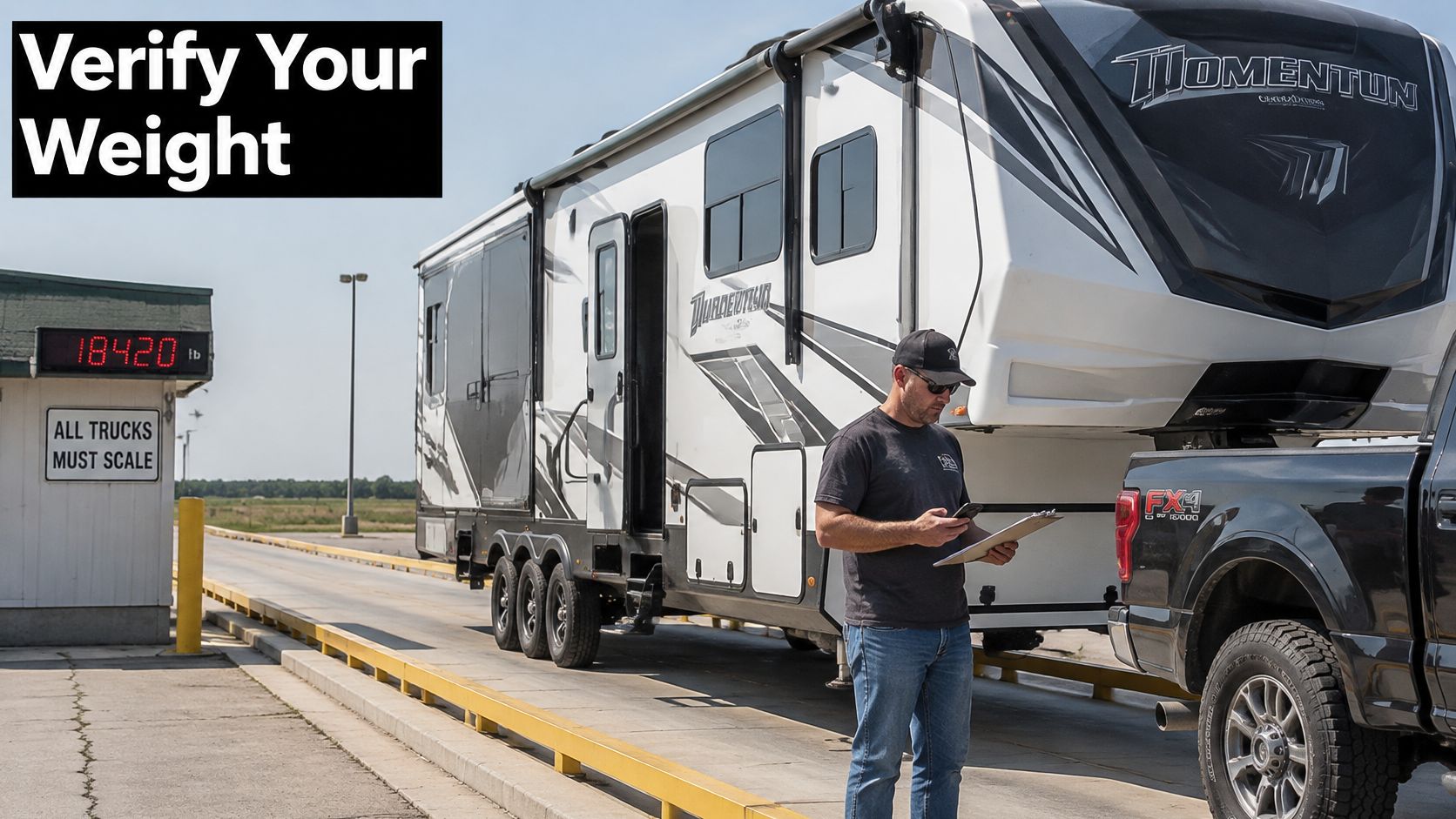
Safety guidance supports that order of operations. NHTSA advice on comparing loaded trailer and pin weight with truck ratings notes that NHTSA advises comparing the loaded trailer weight and manufacturer-specified pin weight with the truck's GVWR, GAWR (especially the rear-axle rating), and tow rating, because exceeding those limits can create safety hazards.
The Weighing Procedure
Start before you leave home. Copy the trailer's certification-plate ratings and your truck's door-jamb figures onto one sheet, then load the trailer in its heaviest realistic configuration, with machines secured and tanks at trip levels. Weigh the combination, and where the scale allows it, get individual axle readings rather than only a single total.
The short video below walks through the weighing process so you can see the sequence before you go.
The scale reading beats marketing figures because it captures installed options, fluids, and trip-ready cargo exactly as carried. Compare each axle reading with its rating, the trailer total with its GVWR, and the truck's loaded weight with its own GVWR. A combination can pass on total weight and still overload the rear axle.
Acting on the Numbers
If an axle is over, move cargo before you remove it. Shifting heavy items changes how weight distributes, and sometimes that alone restores margin. If the trailer total is over GVWR, shifting won't help, and something has to come out.
When the combination runs near its limits and you're unsure of the true pin load, a qualified facility can measure actual king-pin weight for you. That's money well spent before a purchase decision, because it converts your estimate into a measured fact. Keep the scale ticket with your loading list, and reweigh whenever your gear changes.
Floorplan Features Powersports Owners Should Prioritize
Loading day shows you what a floorplan diagram can't. The ramp drops, the first machine rolls in, and suddenly the walkway, the tie-down angles, and the cabinet doors all matter at once. Prioritize features based on that moment, not on how the trailer looks empty.
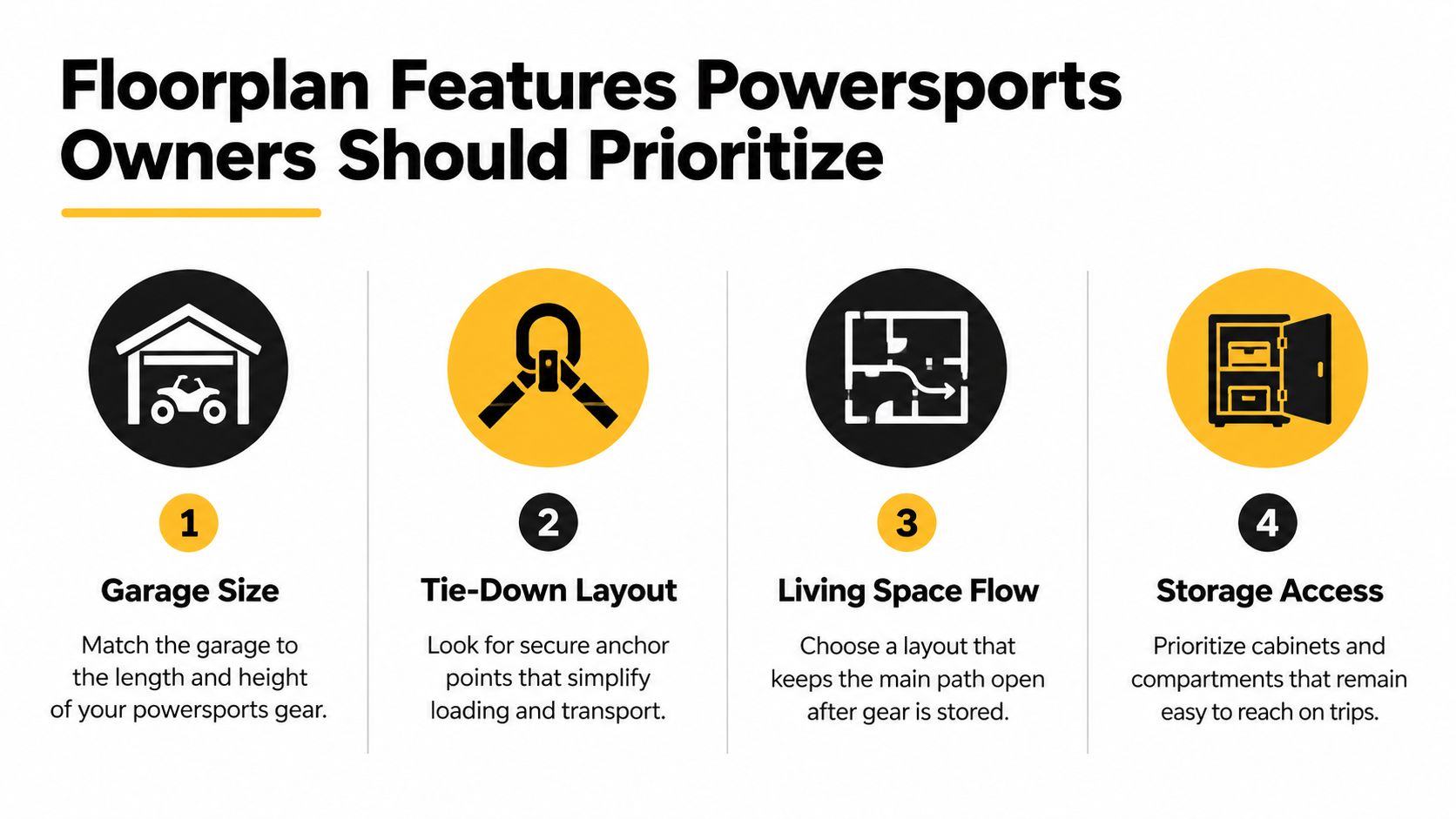
Start with the garage itself. Measure your machines for length, width, and height, then compare those figures with the garage interior, accounting for cabinets, fold-up furniture, and the ramp door hardware. Check that tie-down points sit where your straps need them, and look at how the living area separates from cargo, since fuel smells and trail dirt travel fast in an open layout. Creative sleeping arrangements help too, and these toy hauler bed ideas for Utah adventurers show how garage space can convert once machines are unloaded.
Cargo Placement Is a Stability Decision
Where weight sits changes how the trailer behaves. Federal Fish and Wildlife towing guidance on even weight distribution and low center of gravity recommends distributing trailer weight evenly across the wheels and keeping the center of gravity low, and warns that loading heavy equipment too far forward or aft changes pin loading and stability. Machines loaded forward raise pin weight and rear-axle load. Machines placed too far aft can reduce pin loading but promote sway.
Build these loading habits from the first trip:
- Secure each machine independently: One machine's straps shouldn't be doing another machine's work.
- Balance left and right: Uneven side loading degrades braking and steering feel on winding roads.
- Keep heavy items low: Tools and fuel containers belong on the floor, not on high shelves.
- Recheck after loading: Verify tire pressures and, when your load changes, confirm axle weights at a scale.
On Utah mountain grades, excess rear-axle load shrinks your suspension margin just when braking distances grow. A balanced, low, well-secured load protects the truck, the trailer, and everyone sharing the descent with you.
Choosing and Maintaining Your Lightweight Hauler
Choose backward from the load, not forward from the floorplan. Define your heaviest realistic trip first, with machines, water, fuel, passengers, and supplies included. Then find the lightweight 5th wheel toy hauler whose cargo allowance, GVWR, and likely pin load fit that trip and your truck, with margin left over.
Prioritize based on how you'll travel. Weekend runs to Jordanelle reward a simpler, lighter rig that's easy to hitch and go. Longer stays at Bear Lake put more pressure on water capacity, storage, and living space, and may justify a heavier trailer if your payload supports it. Neither answer is wrong. Buying for a trip style you never take is wrong.
A Maintenance Routine That Protects the Math
Your weight calculations only stay true if the equipment stays sound:
- Reweigh after gear changes: A new machine or added battery bank can move you closer to a limit than you expect.
- Inspect tires and axles regularly: Tire condition and pressure matter more as loads approach ratings.
- Keep loading records: Save scale tickets and your cargo list together so changes are easy to spot.
- Prepare for winter storage: Utah winters punish neglected plumbing, batteries, and tires, so winterize and store deliberately.
Motor Sportsland supports that process from its Millcreek and Spanish Fork locations, where shoppers can browse new and used inventory by weight, length, and floorplan, discuss trade-in and financing options, and use the Service Center for maintenance checks, hitch and electrical work, and parts. Bring a photo of your truck's door-jamb sticker and your written gear list, and our team can run the payload math with you against specific trailers on the lot. That one step, done before you fall for a floorplan, prevents most of the expensive mismatches in this category.
Ready to match a lightweight toy hauler to your truck's real payload and your actual gear list? Visit Motor Sportsland to browse current fifth-wheel toy hauler inventory by weight and floorplan, or stop by our Millcreek or Spanish Fork showroom with your door-jamb sticker photo in hand. Our team will run the cargo and pin-weight numbers with you, talk through financing or trade-in options, and make sure your rig is ready for Utah's mountain grades before your first trip.
