
Pros and Cons of Travel Trailers for Utah Adventures

You're loading camping chairs outside your Salt Lake City home, the kids are choosing bunks, and the weekend plan points toward Bear Lake. Then the practical questions start. Can your truck handle the trailer when it's loaded? Where will you park it afterward? Will the campground accommodate the floorplan everyone loves?
Those questions capture the pros and cons of travel trailers better than a showroom price tag. A trailer can give you a comfortable base camp and the freedom to explore without moving your living space. That flexibility works best when your tow vehicle, floorplan, storage arrangement, and travel habits fit together.
At Motor Sportsland, we help Utah buyers connect those decisions rather than shop for sleeping capacity alone. Our experience serving local RV owners spans more than 55 years, with locations in Millcreek and Spanish Fork and support for shopping, financing, maintenance, and repairs.
The right purchase isn't necessarily the largest trailer your truck can pull or the lowest payment you can arrange. It's the trailer you can tow comfortably, maintain consistently, store sensibly, and use. These eight trade-offs will help you compare lightweight travel trailers, family bunkhouses, and larger layouts against what Utah camping demands.
1. Lower Upfront Cost vs. Faster Depreciation and the Price Reality of Travel Trailers
A lower purchase price is an advantage, not a complete ownership budget. A travel trailer can offer a more affordable route into RV ownership than a motorhome, especially when you already own a suitable tow vehicle. The RV Industry Association's history of RVs explains the towable format's enduring appeal, including the ability to detach the living unit and use the vehicle separately.
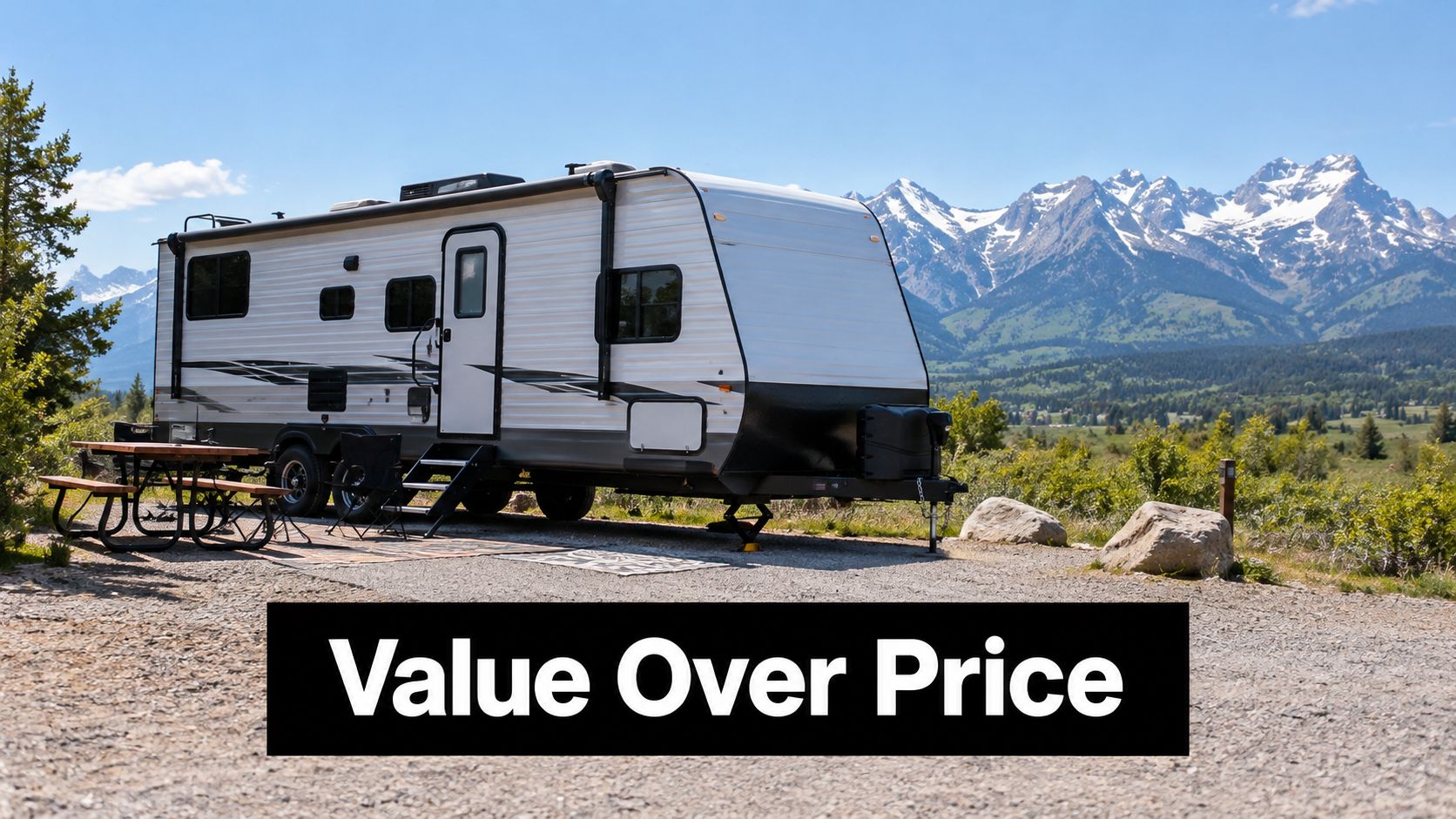
Depreciation deserves attention, but don't assume every trailer loses value at the same pace or depreciates faster than every motorhome. Condition, purchase price, floorplan demand, and the eventual selling market all matter. There's no dependable resale percentage to apply across every model.
Consider a family comparing a new bunkhouse with a used Jayco or Keystone layout for weekends at Jordanelle. The used trailer might leave more room for hitch equipment and storage, but only if its roof, appliances, tires, and service history withstand inspection. A discounted purchase can become expensive if deferred repairs consume the savings.
Compare the Complete Purchase
- Separate equipment costs: Include the hitch, brake controller, batteries, and any required tow-vehicle changes.
- Request written pricing: Distinguish the trailer price, taxes, fees, optional products, and financing charges.
- Evaluate used condition: Look beyond upholstery and exterior graphics to seals, floors, systems, and maintenance records.
- Plan your exit: Compare likely loan balance with conservative resale expectations before assuming an easy trade-in.
Owner's Picks and Deals of the Week are useful starting points in our inventory, not substitutes for inspection. The broader lease-or-buy decision framework can help organize questions about ownership and flexibility, but automotive examples shouldn't be treated as RV depreciation forecasts.
2. Towing Capacity and Mountain Driving When Matching Your Tow Vehicle to Utah Grades
The trailer looks manageable on the dealership lot. Loaded for a climb through the Wasatch Mountains, it's a different combination. Food, water, propane, batteries, passengers, and recreational equipment all belong in your towing calculations.
Start with the specific truck or SUV, not the model name. Read its certification labels and manufacturer documentation, then compare payload, axle ratings, receiver limits, trailer ratings, and combined-weight limits. Our guide to understanding maximum towing capacity explains why a headline tow rating isn't the whole answer.
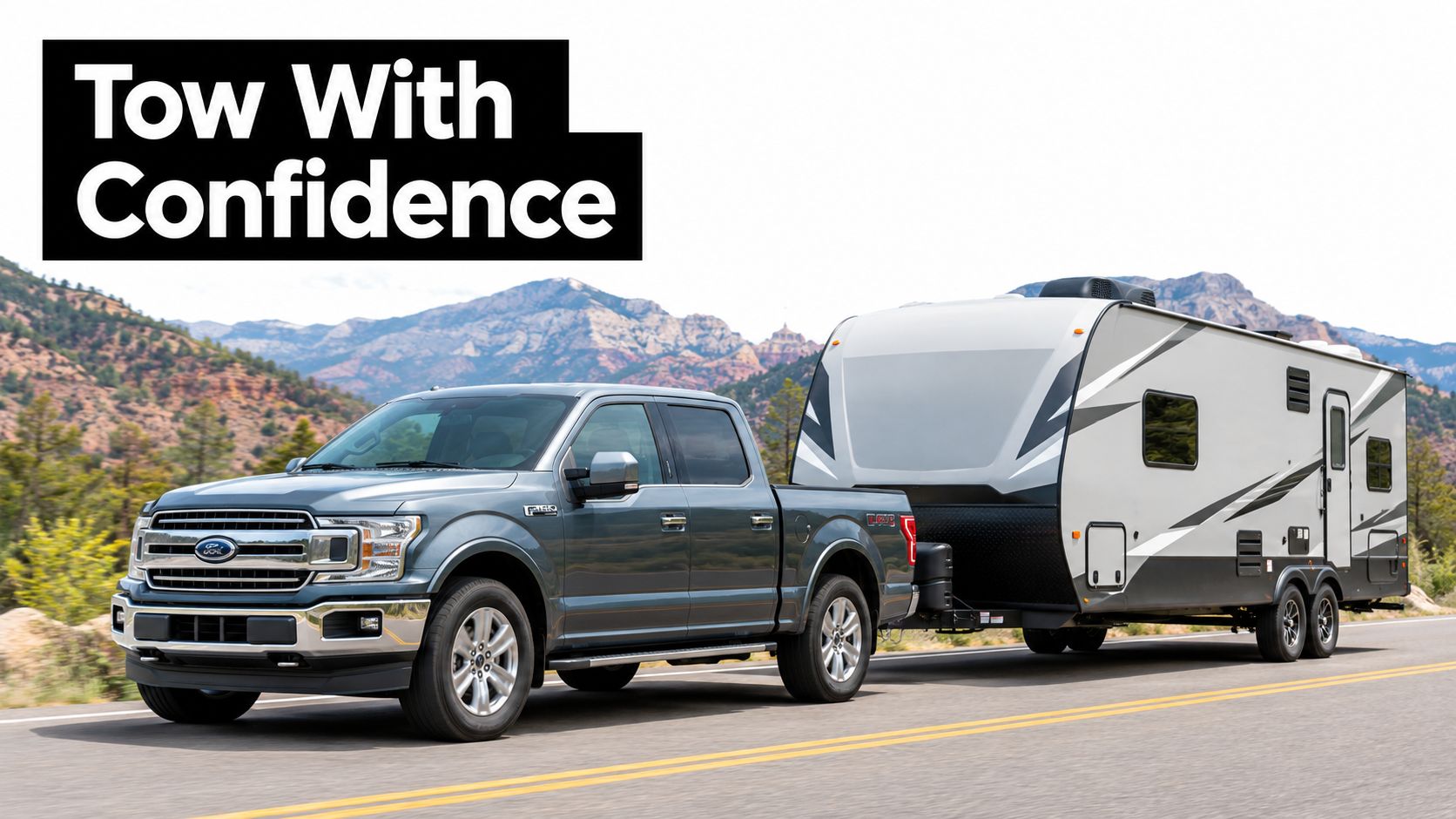
For conventional trailers, loaded tongue weight should generally be 10%–15% of gross trailer weight, according to North Carolina's safe trailering guidance. Use actual camping weight rather than treating the brochure's dry weight as your departure weight.
Match the Whole Combination
A family heading toward Strawberry might fit within the truck's advertised towing limit yet run short of payload after adding passengers, bicycles, and hitch hardware. That's why a loaded scale visit is more useful than reassurance based only on engine size.
- Verify the load: Compare scale measurements with the applicable vehicle and trailer ratings.
- Prepare for descents: Learn the manufacturer's instructions for tow mode, lower gears, and engine braking.
- Check towing equipment: Confirm brake-controller operation, tire ratings, hitch compatibility, and wiring before departure.
Mountain-driving rule: Equipment can help a properly matched combination perform correctly. It can't make an overloaded combination acceptable.
Don't treat a transmission cooler or weight-distribution hitch as permission to exceed a rating. Choose enough capacity to accommodate your real camping load and the demands of your intended routes.
3. Fuel Economy and Running Costs When Towing Changes Your Gas Budget
A trailer doesn't have an engine, but moving it still requires fuel. Its frontal area, loaded weight, your speed, and the conditions along the route all affect what you'll spend.
Real-world towing references commonly describe fuel-economy reductions of roughly 30%–50%, with many truck-and-trailer combinations returning approximately 8–14 mpg, depending on the setup and conditions, according to this towing fuel-economy overview. Treat those figures as planning context, not a promise for your vehicle.
The aerodynamic penalty matters as much as the weight discussion. In a Department of Energy test, a large box trailer loaded to the vehicle's maximum allowable towing capacity doubled an SUV's fuel consumption above 65 mph, as documented in the DOE fuel-economy presentation. That result describes the tested combination, not every travel trailer.
Budget Around Your Own Trips
For a Millcreek family planning a Flaming Gorge weekend, the useful comparison isn't the truck's daily commuting mileage. It's the fuel required for the loaded round trip, including campground access and local driving after unhitching.
- Keep a towing log: Record fuel purchased, distance, load, route, and weather to build a realistic estimate.
- Moderate your speed: Stay within applicable limits and the guidance for your tires and towing equipment.
- Avoid unnecessary cargo: Bring what the trip requires rather than leaving heavy equipment aboard indefinitely.
- Plan sensible stops: Choose fuel stations with enough access and turning room for the entire combination.
The upside remains useful: once camp is established, you can explore without towing the trailer everywhere. For travelers who spend longer in each destination, that separation can make the extra fuel used on travel days easier to justify.
4. Storage, HOA Rules, and Utah Winters Between Camping Trips
Where will the trailer live on an ordinary weekday? If the answer is uncertain, pause before choosing a floorplan.
Storage belongs in the buying decision, not the delivery-day scramble. Check your property restrictions, HOA documents, local parking requirements, and the terms of any storage facility directly. Don't assume a neighbor's parking arrangement means yours will be permitted.
A hypothetical Salt Lake County buyer might have enough driveway length but discover that the gate, turning angle, or neighborhood rules make home storage impractical. A paid space could solve that problem while changing the ownership budget and adding travel time before every camping trip.
Prepare for Storage, Not Just Parking
- Measure the approach: Account for the hitch, obstacles, overhead clearance, and room to maneuver.
- Compare access: Ask whether the facility's hours work with early departures and late returns.
- Plan winterization: Follow the trailer and appliance manufacturers' procedures before freezing conditions.
- Inspect before covering: Address suspected leaks rather than hiding them beneath a cover.
Winterization isn't just draining a visible tank. Water heaters, pumps, low-point drains, toilets, exterior showers, and other fitted equipment need the correct procedure for that trailer. If you're unsure, have our service team explain the process or handle the work.
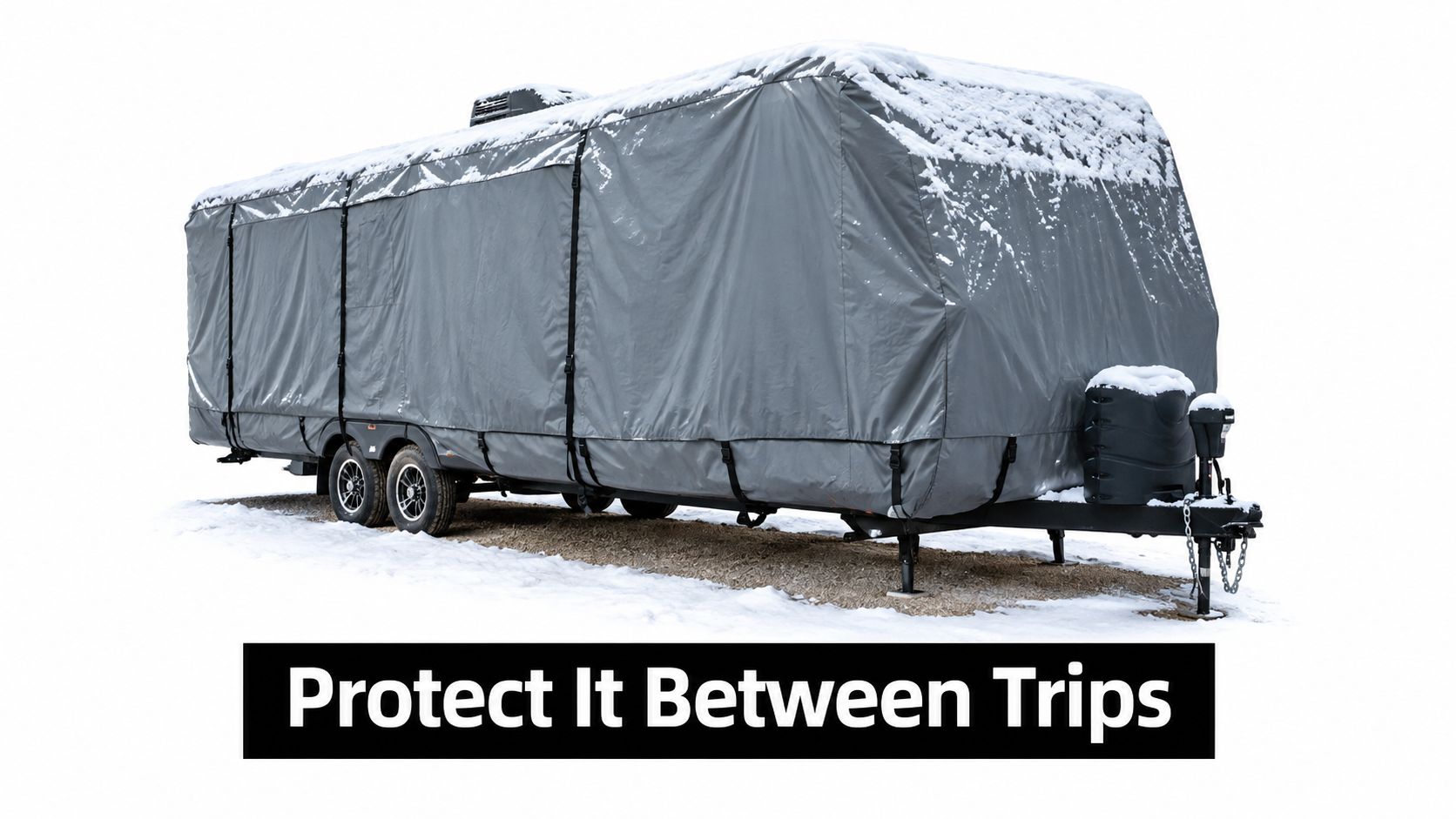
A breathable, properly fitted RV cover may be appropriate, but confirm compatibility and installation guidance. Before spring travel, inspect the roof, seals, tires, batteries, and water system rather than assuming a parked trailer is ready to tow.
5. Setup, Hitching, and the Skills New Owners Need to Master
Backing into a campsite at Bear Lake is much easier when it isn't your first attempt at reversing a trailer. The learning curve is real, but you can practice most essential skills before a crowded campground adds pressure.
Start with a pickup walkthrough that goes beyond appliance switches. Ask how to couple the trailer, confirm the latch, connect the breakaway system, test the brakes, and complete a final walkaround.
Utah requires a safety chain, cable, or equivalent connection in addition to the regular hitch, with attachment, strength, and slack requirements described in Utah's towing safety statute. It's a deliberate safety connection, not an accessory to clip on without checking.
Build a Repeatable Routine
- Practice backing: Use an appropriate open area, a spotter, and agreed hand signals.
- Inspect the coupling: Verify engagement according to the hitch and coupler instructions.
- Check before moving: Confirm lights, brakes, tire pressure, secured doors, retracted equipment, and disconnected utilities.
- Recheck after interruptions: Return to your written process if a conversation or distraction breaks your sequence.
A weight-distribution system may be appropriate for your combination, but correct selection and adjustment matter. Our explanation of how a weight-distribution hitch works provides useful preparation for a hands-on equipment discussion.
Use this video as a supplement to your trailer-specific walkthrough, not a replacement for the manufacturer's instructions.
A calm departure routine is more valuable than trying to hitch faster than the campsite next door.
At pickup, ask our team to demonstrate the steps, then repeat them yourself. Operating the equipment while someone can answer questions is far more useful than discovering an unfamiliar connection after dark.
6. Campsite Flexibility vs. Campground Competition in Utah
The strongest lifestyle advantage of a travel trailer is the base-camp arrangement. Park, settle in, and use the tow vehicle for groceries, sightseeing, or a drive toward the Great Salt Lake without packing up your beds and kitchen.
That flexibility doesn't guarantee an available campsite. A 2025 survey of more than 2,000 RV enthusiasts found that 59% identified crowded campgrounds as a major anxiety and 53% cited a lack of available campsites, according to the Harvest Hosts and Progressive travel-pattern summary.
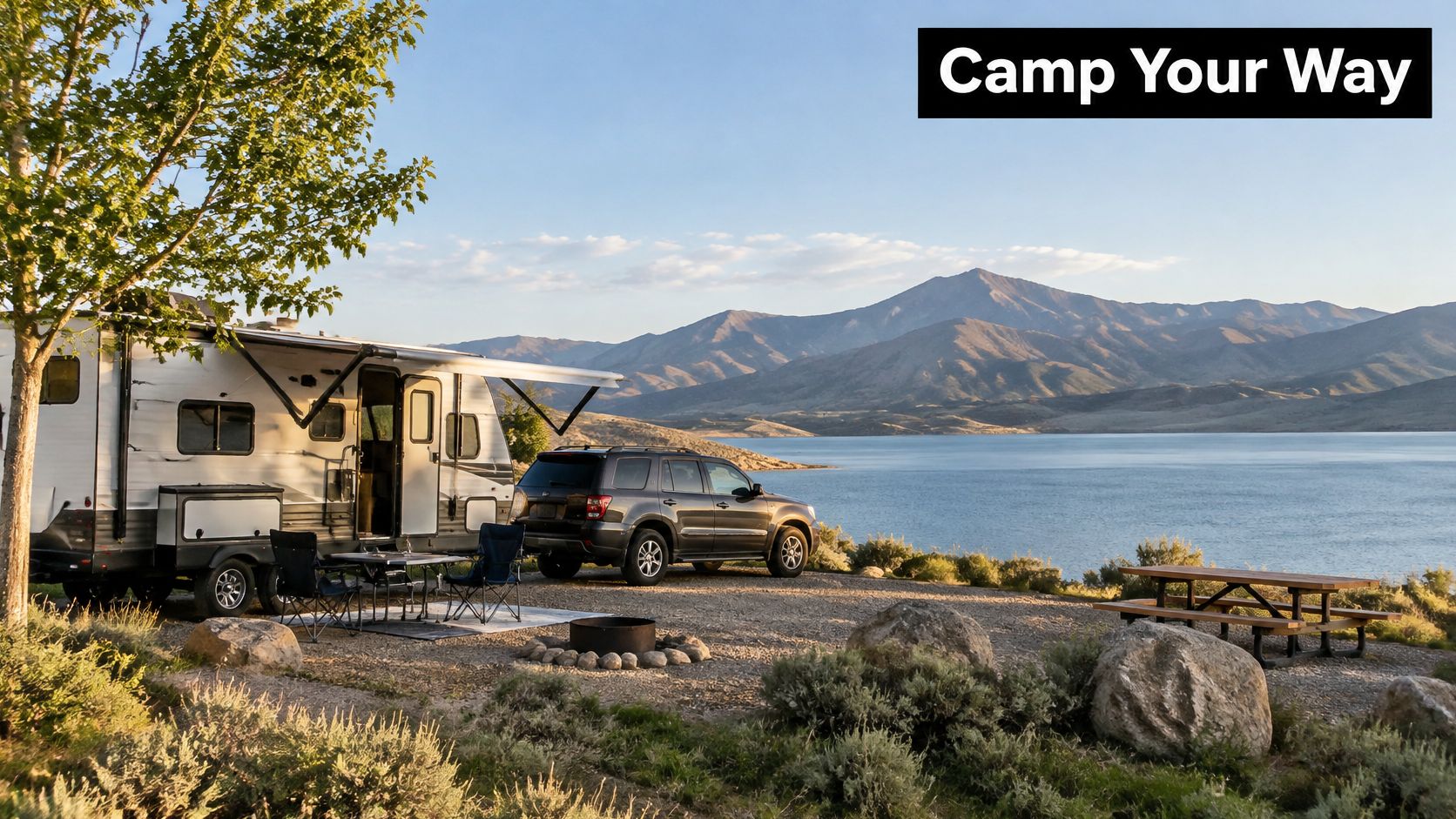
Consider retirees planning a Moab-area stay. A comfortable rear-living layout might suit extended evenings indoors, but the campground still needs an appropriate site and an accessible approach. A family choosing between bunkhouses should make the same check before assuming more sleeping space means more travel options.
Buy for the Places You Want to Camp
- Verify site dimensions: Confirm how the campground measures length and whether the tow vehicle must fit within the space.
- Check the approach: Review access restrictions, turning room, surface conditions, and arrival instructions.
- Confirm utilities: Match hookups and facilities to your trailer and camping habits.
- Keep alternatives: Identify another suitable destination before committing to a tightly scheduled trip.
There's no universal booking lead time. Check each campground's reservation window and availability directly, especially for Jordanelle, Bear Lake's Rendezvous Beach area, and other destinations on your wish list.
A smaller trailer can be the more useful trailer if its dimensions better match your preferred sites. Don't buy extra bunks for occasional guests at the expense of the camping trips you want to take.
7. Maintenance, Weather Exposure, and High-Altitude Travel Trailer Care
No engine in the trailer means no trailer engine service. It doesn't mean maintenance-free ownership.
A travel trailer still needs attention to its roof, seals, running gear, brakes, plumbing, electrical equipment, and appliances. For Utah travel, build your maintenance plan around the manufacturer's instructions, storage conditions, and the routes you'll use, not just the number of camping nights.
A useful example is a trailer returning from the Uinta Mountains with a small area of deteriorating sealant. Addressing it before further exposure is a better decision than waiting for an interior stain. That's a preventive-care scenario, not a guarantee that every seal defect produces the same damage.
Inspect by System
- Roof and exterior: Look for damaged sealant, loose trim, debris, and suspected water entry using safe access methods.
- Tires and running gear: Check pressure, visible condition, age information, wheel requirements, and the manufacturer's replacement guidance.
- Water and electrical systems: Test normal operation and investigate leaks, damaged cables, or unreliable connections.
- Propane and appliances: Arrange qualified inspection when you notice an odor, damage, or abnormal operation.
High-altitude camping also calls for equipment-specific preparation. Check appliance manuals for elevation limitations and operating guidance, and confirm that your battery, heating, and water plans suit the forecast. Don't assume every campground near a mountain destination offers hookups.
Service priority: Tell the technician what you noticed, when it happens, and whether the trailer is connected to shore power, water, or the tow vehicle.
Our Service Center handles maintenance, repairs, installations, plumbing, electrical work, and related RV service. Scheduling a review before an important trip gives you time to address findings rather than discovering them while packing.
8. Financing, Insurance, and Trade-In Value When Protecting Your Investment
An affordable payment and an affordable trailer aren't necessarily the same thing. Compare the purchase contract, loan structure, insurance, storage, maintenance, and anticipated use before deciding what fits your budget.
Loan offers and insurance requirements need to be confirmed for the specific transaction. Ask the lender about the interest rate, repayment term, fees, down payment, and any prepayment conditions, then obtain an insurance quote for the actual trailer.
For buyers concerned about credit, our guide to RV financing with fair credit can help you prepare questions. Pre-qualification is a useful planning step, but don't treat it as a substitute for reviewing final approval and contract terms.
Make the Next Trade Part of Today's Decision
A family upgrading from a compact trailer to a bunkhouse should request both a written trade appraisal and a current loan payoff. Equity is the difference between those figures, not the amount of the original down payment.
- Compare total borrowing cost: Review more than the monthly payment when evaluating offers.
- Clarify insurance coverage: Ask about liability, physical damage, deductibles, stored use, storm damage, and exclusions.
- Keep service records: Save invoices and document maintenance so an appraiser can evaluate the trailer's care.
- Separate transactions: Understand the purchase price, trade allowance, payoff, and financing rather than judging only the final payment.
The tow system deserves equal financial attention. NHTSA's towing guidance discussion emphasizes determining fully loaded tongue weight and comparing it with applicable axle ratings. Don't finance a trailer first and discover afterward that making the combination suitable requires a different tow vehicle.
The best financing arrangement still starts with the right trailer. Borrowing less won't make an unsuitable floorplan useful, and a comfortable payment won't correct a weight mismatch.
Travel Trailer Pros and Cons: 8-Point Comparison
| Topic | Complexity and Speed 🔄⚡ | Resource Requirements | Expected Outcome 📊 | Ideal Use Case 💡 | Key Advantage ⭐ |
|---|---|---|---|---|---|
| Upfront Cost and Depreciation | 🔄 Low purchase barrier; compare ownership costs over 3–5 years | Purchase budget, financing, insurance, storage, and accessories | 📊 Used trailers can avoid the steepest early depreciation | First-time buyers and families seeking a lower entry price | ⭐ Broad price range and strong value in gently used models |
| Towing Capacity and Mountain Driving | 🔄 Requires checking ratings, loaded weight, and hitch setup | Suitable tow vehicle, brake controller, hitch, and optional weighing service | 📊 Proper matching reduces strain and improves stability on grades | Owners towing in Utah's mountains or over long distances | ⭐ Many smaller trailers can work with an existing capable vehicle |
| Fuel Economy and Running Costs | 🔄 Moderate; track fuel and routine expenses across trips | Fuel, tires, brakes, propane, insurance, and campground fees | 📊 More realistic trip budgets and fewer cost surprises | Frequent travelers and buyers comparing trailer sizes | ⭐ Tow vehicle remains available for everyday driving when unhitched |
| Storage, HOA Rules, and Utah Winters | 🔄 Moderate; confirm rules and prepare for seasonal storage | Legal parking space, possible storage fees, covers, and winterization supplies | 📊 Better protection from weather damage and fewer storage conflicts | Buyers planning to store a trailer through Utah winters | ⭐ Trailer and tow vehicle can be stored separately |
| Setup, Hitching, and Learning Curve | 🔄 Moderate at first; setup often becomes routine with practice | Hitch and safety gear, checklists, and time to practice | 📊 Safer towing and smoother campsite arrivals | First-time owners and people new to trailer camping | ⭐ Detachable trailer lets owners explore without moving camp |
| Campsite Flexibility and Competition | 🔄 Moderate; research site length, hookups, and reservations | Advance planning, reservation tools, and supplies for dry camping | 📊 Access to varied camping styles, subject to availability and site limits | Families and travelers visiting Utah parks or remote areas | ⭐ Unhitch and use the tow vehicle for local trips |
| Maintenance, Weather, and High-Altitude Care | 🔄 Ongoing; seasonal checks and scheduled service | Inspection time, replacement parts, tires, and service budget | 📊 Fewer preventable breakdowns and better long-term condition | Owners camping often or storing trailers outdoors | ⭐ Preventive care can help avoid costly repairs and preserve value |
| Financing, Insurance, and Trade-In Value | 🔄 Moderate; compare loan terms, coverage, and appraisals | Credit application, insurance quotes, down payment, and maintenance records | 📊 Clearer ownership costs and fewer surprises when upgrading | Buyers financing a trailer or planning a future trade-in | ⭐ Pre-qualification and trade-ins can help manage purchase costs |
Choose the Trailer That Fits Your Real Life
A trailer can feel right on the lot and still be wrong after the first icy morning, first canyon climb, or first HOA warning. The pros and cons of travel trailers come down to whether the flexibility earns its keep in your household. Lower entry cost, a familiar tow vehicle, and the freedom to unhitch can make ownership rewarding. Towing preparation, campsite reservations, storage, winter protection, and routine maintenance are the other side of that decision.
Start with the trips you expect to take, not the longest feature list. A trailer for frequent weekends near home may need a different balance of size, cargo capacity, and comfort than one intended for extended Mountain West travel. Be honest about how often you will camp, which grades you will tow, where the trailer will sit between trips, and how much preparation you are willing to do.
Match the Layout to the People Traveling
Families should compare usable bunks and loaded capacity together. Sit at the dinette, check bathroom access, and consider where shoes, food, outdoor gear, and wet clothing will go. Sleeping capacity alone does not establish whether everyone can travel comfortably within the combination's limits.
Retirees should prioritize everyday comfort and manageable routines. Test bed access, seating, storage, entry steps, and setup tasks rather than choosing a floorplan solely because it looks spacious. A comfortable trailer is one you can use confidently after a long drive.
First-time buyers should favor a manageable combination over maximum size. A lightweight model deserves consideration when it fits the people, equipment, and destinations involved. Toy hauler shoppers need the same discipline, with particular attention to how recreational cargo changes the loaded configuration.
Before committing, bring together the decisions that are often handled separately:
- Tow vehicle: Verify the ratings and the expected camping load.
- Routes and seasons: Consider mountain grades, fuel stops, wind, snow shoulder seasons, and turnaround space.
- Destinations: Check whether suitable campsites are available where you want to travel.
- Storage: Confirm permission, access, cost, and winter preparation.
- Ownership budget: Include equipment, insurance, maintenance, fuel, camping fees, storage, and expected depreciation.
At Motor Sportsland, our role is to help you compare those trade-offs without treating every buyer as a match for the same trailer. Bring your vehicle information, preferred destinations, and budget questions to our Millcreek or Spanish Fork showroom. You can also browse inventory online or arrange service before your next trip, so the decision starts with your actual needs rather than guesswork.
Motor Sportsland offers new and used RVs, financing options, and service support to help you choose and care for a travel trailer that fits Utah travel. Visit Motor Sportsland to browse inventory, arrange a personalized consultation at our Millcreek or Spanish Fork showroom, or schedule a towing-equipment and maintenance review before your next adventure.
