
Travel Trailers with Two Bedrooms: Buyer's Guide for 2026

You've found a trailer with enough beds for everyone, but you're still picturing bedtime. The kids are asleep, someone needs the bathroom, and you'd like to sit down without folding away half the living room. That's where travel trailers with two bedrooms can make camping easier, provided the second bedroom gives you useful separation rather than just another sleeping surface.
The catch is that bedroom labels don't tell you much about doors, mattress sizes, nighttime access, or towing weight. A private bunkroom and a lounge full of sofa beds can both accommodate a family, but they work very differently at a Utah campground.
At Motor Sportsland, we encourage buyers to start with how they'll use the trailer, not its advertised sleeping capacity. For trips from Salt Lake City to Bear Lake or into the Wasatch Mountains, the right choice needs to work both parked and hitched.
Before committing, compare each layout in daytime and sleeping configurations, measure the space you'll use, and match the loaded trailer to your tow vehicle. A smaller bunkhouse that passes those tests can be a better family trailer than a larger model with an impressive bedroom count.
Two-Bedroom Floorplans Compared
A fixed bunkroom keeps beds ready, while a lounge with convertible sofas preserves more seating during the day. Compare each layout in both modes: where people sit before bedtime, and what remains usable once the beds are set up.
Two-bedroom floorplan types and what they deliver
The rear-lounge figures below are from Forest River's Rockwood Ultra Lite 2921RL floorplan specifications. The layout has a front queen, two 60-inch hide-a-bed sofas, 35 feet 4 inches of exterior length, and 820 pounds of published hitch weight.
| Floorplan | How Beds Are Set Up | Privacy | Towing Impact | Best Fit |
|---|---|---|---|---|
| Bunkhouse with fixed bunks | Bunks in rear room, queen in main bedroom | Kids share a room, adults keep their sleeping area | Compare the trailer's actual length and weight with other layouts; specifications vary | Families with young children |
| Rear bedroom with queen | Queen in rear, bunks or sofa bed in main area | Door separates adult and child sleeping areas | A longer body can add towing weight; check the loaded figures | Couples or families wanting a guest room |
| Front bedroom with rear lounge | One queen in front, two 60-inch hide-a-bed sofas in lounge | Bedroom is private, lounge is shared | The Rockwood Ultra Lite 2921RL is 35 feet 4 inches long, with 820 pounds of published hitch weight | Families wanting daytime lounge seating |
| Two fully private bedrooms | A bed in each enclosed room | Both rooms close off | Extra walls and furnishings can mean more length and weight; compare specifications | Multigenerational groups needing a true guest room |
With fixed bunks, children can leave bedding in place. Check whether the room has a solid door, a curtain, or an open entrance. A door provides visual separation, but it may not block conversation or television noise.
A rear queen can give adult guests a more comfortable sleeping space than child-sized bunks. If children sleep on convertible furniture in the main area, though, adults may lose access to seating or the kitchen after bedtime. Check how the room works for everyone once the beds are made.
A lounge isn't a second private bedroom
The Rockwood's two sofa beds provide daytime seating, but opening them takes up living-room floor space. Check where the coffee table, cushions, shoes, and bedding go during the conversion.
Two enclosed rooms suit guests who need separate changing space and routines. The trade-off is more room dedicated to walls, cabinetry, and furnishings. Compare what that space adds to privacy with its effect on the trailer's overall size and weight.
Buying rule: Check bed sizes, doors, and usable floor space in both daytime and sleeping configurations.
Who Two-Bedroom Trailers Suit Best
Conventional travel trailers are the most commonly owned RV category, owned by 38% of RV owners, according to the RV Industry Association's travel-trailer owner profile. That profile reports that 27% of travel-trailer owners travel with children under 18, 87% with a spouse, and 26% with a pet; it also identifies 29% as first-time RV owners.
Those are different travel parties, not a single ideal buyer. Choose a layout around the people who regularly come along.
Match the room to its regular occupants
Young families benefit from a bunkroom when children need an earlier bedtime than adults. Ask whether the bunks will still suit them as they grow, including mattress length, headroom, and access to the upper bed. Our guide to bunkhouse travel trailers for families can help narrow that comparison.
Multigenerational groups should prioritize adult bed access. Can grandparents get around the mattress without climbing over someone? A private room loses much of its value if reaching the bathroom requires squeezing through converted furniture.
Couples wanting an office or guest room should check desk placement, outlets, ventilation, and storage before assuming an unused bunkroom will convert easily. Built-in bunks aren't automatically removable.
First-time buyers should decide how much setup they'll tolerate. A flexible lounge may suit occasional guests, while fixed beds make repeated family trips less work.
For weekends at Jordanelle or longer stays at Bear Lake, useful separation matters more than an ambitious sleeping-capacity label.
Consider a single-bedroom trailer or simpler bunkhouse if:
- Guests rarely join you: Don't tow an unused room on every trip.
- Payload is already tight: A larger floorplan won't solve a tow-vehicle limitation.
- You prefer compact campsites: Put maneuverability ahead of extra interior doors.
Test Privacy Against Towing and Daily Life
Can children reach their beds without crossing the main bedroom? Can adults use the bathroom or kitchen after bedtime without disturbing sleepers? Can the second room become storage, an office, or a guest room when your family's needs change?
These questions reveal more than standing in an empty trailer with every slide extended. Test the trailer as an occupied home, with bedding, shoes, bags, and people moving through it.
A well-designed bunkhouse can give a family more usable space and easier towing than a nominal two-bedroom floorplan. That happens when compact fixed beds preserve the central living area instead of dedicating substantial floor space to a room used only overnight. It's a layout judgment, not a guarantee that every bunkhouse is smaller.
Run a day-versus-sleep walkthrough
Bring a tape measure, your camping checklist, and the people who'll use the beds. Customers who come into Motor Sportsland can be shown around any trailer they want to see.
Ask for a complete demonstration:
- Start in daytime configuration. Sit at the dinette, open the refrigerator, and check whether people can pass each other.
- Make every bed. Include ladders, mattress extensions, sofa mechanisms, and the space needed to unfold them.
- Simulate a nighttime bathroom trip. With safe lighting, have a child follow the route and note awkward steps or blocked doors.
- Retract the slides. Have the salesperson operate them and measure the remaining aisle clearance.
- Locate overnight essentials. Check access to medicine, coats, drinking water, and the bathroom during a roadside stop.
Don't climb into bunks or operate moving components without the salesperson's guidance. Check each bed's stated load limit before using it.
Think beyond a single weekend
The median owner used an RV for 30 days in 2025, up 50% from 2021, according to the RV Dealers Association's summary of the Go RVing owner profile. Repeated conversion, awkward bathroom access, and poor storage become more noticeable as trips get longer.
For off-grid camping, bathroom planning also includes water use, waste handling, and maintenance. Everti's practical sanitation advice for off-grid travel offers context if you're considering a composting-toilet arrangement, rather than assuming a bathroom modification is a simple swap.
For Jordanelle and Bear Lake trips, check the specific site's approach and parking dimensions rather than assuming every campground accommodates a long rear room. On mountain routes, avoid using rear storage as an unrestricted dumping ground for heavy gear.
Choose the room you'll use comfortably, not the room count you'll mention when describing the trailer.
Sizing for Length, Width and Height
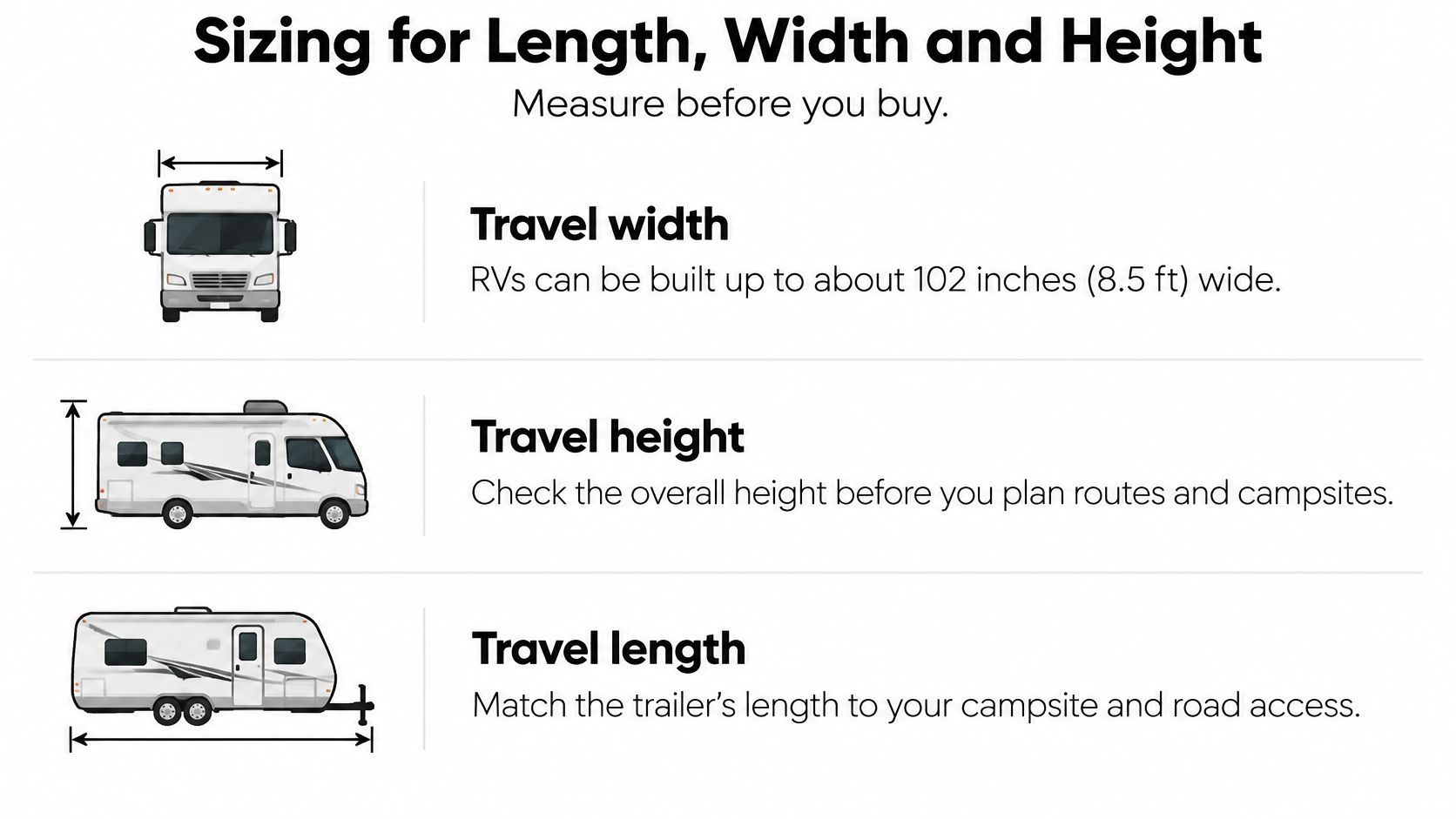
RV industry material describes RVs built up to 102 inches, or 8.5 feet, wide in travel mode and up to 45 feet long, excluding specified projecting equipment from the width measurement; see the RV Industry Association's RV Report. These are broad industry dimensions, not permission to skip checking route restrictions or the specifications of a particular trailer.
Use this visual as a reminder of what to measure.
Size benchmarks for two-bedroom travel trailers
For a concrete size reference, Winnebago's Thrive 25RLS specifications list 30 feet 2 inches of length, 11 feet 2 inches of height, and 6,512 pounds of dry weight. It's a rear-living model, not a dedicated two-bedroom trailer, so use it as a dimensional benchmark rather than a family-floorplan recommendation.
| Dimension | Benchmark | Research Example | Why It Matters |
|---|---|---|---|
| Travel width | About 102 inches maximum in the industry material above | Measure with slides retracted | Road clearance and campsite fit |
| Overall length | RV industry envelope extends up to 45 feet | Thrive example above; compare the Rockwood rear-lounge configuration by its published overall length | Campsite length and turning room |
| Height | Verify with air conditioner installed | Thrive specification above | Fuel canopies, older bridges, tree limbs |
| Dry weight | Starting figure only | Thrive dry-weight specification above | Not the loaded trip weight |
Travel width means the trailer's road configuration, not its expanded campsite footprint. Check additional clearance for slide deployment, entry steps, awnings, and neighboring vegetation.
Overall length needs a consistent measuring method. Find out whether the advertised measurement already includes the coupler. If it describes the body only, add the hitch section; don't add it twice to a manufacturer's overall-length figure.
Measure the whole camping setup
For height, confirm whether the manufacturer's specification includes the installed air conditioner and other rooftop equipment. Don't automatically add an air conditioner's height to a figure that already includes it. Record the actual travel height where the driver can readily see it.
Bunk cabinetry, privacy walls, and slide hardware all take space and add mass. A roomy bedroom can therefore affect campsite access even when the trailer's sleeping capacity seems modest.
Compare overall trailer length with the site's listed equipment allowance, then confirm where the tow vehicle can park and how you'll turn into the space. Before shopping, write down travel-mode exterior width and overall height with rooftop equipment installed, alongside your storage-space measurements.
Weight, Tongue Load and Tow Vehicle Matching
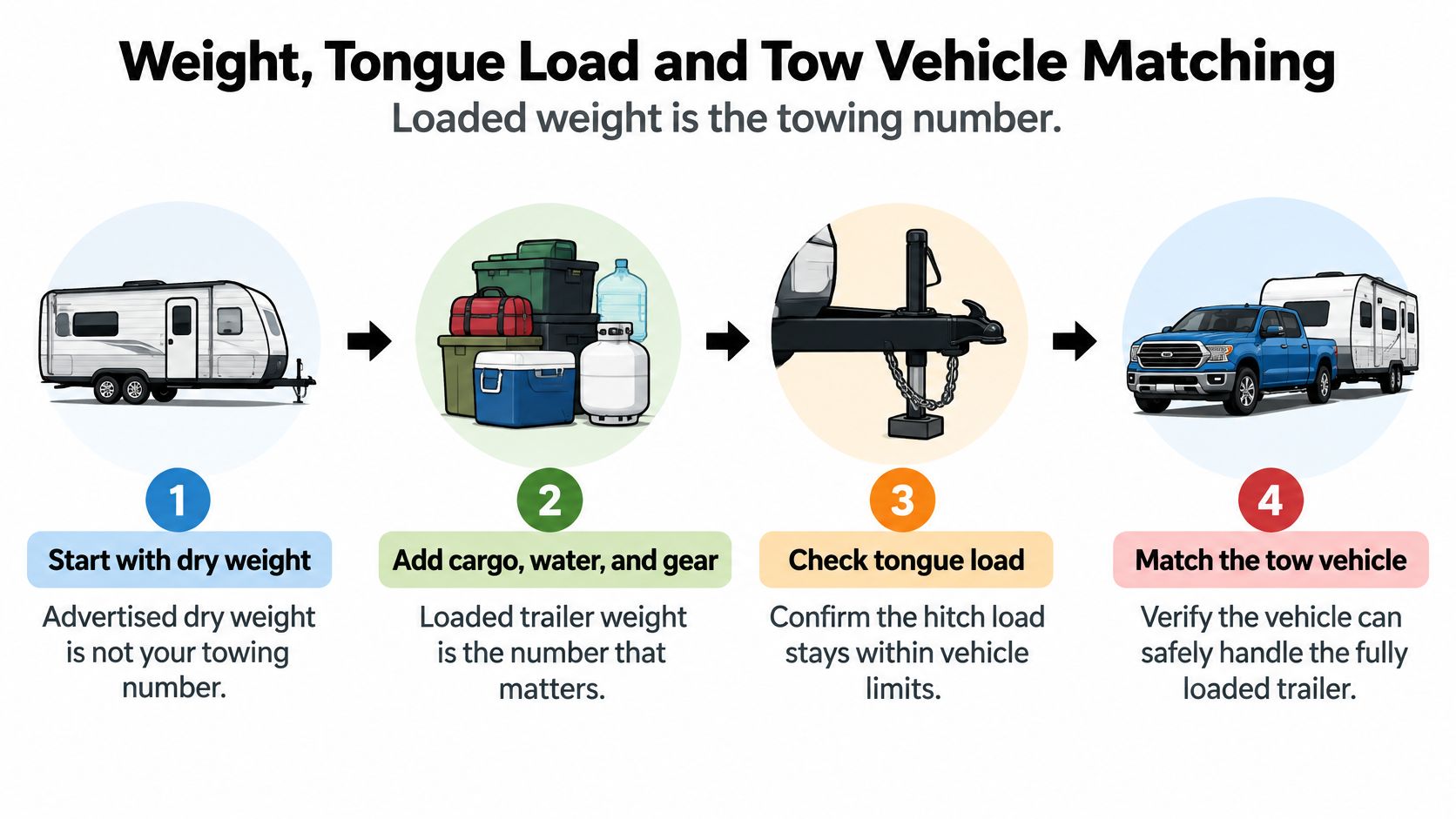
Advertised dry weight isn't your towing number. You need the trailer's loaded weight, its actual tongue load, and the remaining capacity of the vehicle carrying that load.
The North Carolina safe-trailering guide gives a tongue-weight range of 10% to 15% of gross trailer weight. The following calculations apply that range; they aren't substitutes for the instructions and ratings supplied by your vehicle, trailer, and hitch manufacturers.
Tongue load at common loaded trailer weights
| Loaded Trailer Weight | Minimum Tongue Load (10%) | Maximum Tongue Load (15%) | Check Before Towing |
|---|---|---|---|
| 5,000 lb | 500 lb | 750 lb | Confirm on a certified scale |
| 7,500 lb | 750 lb | 1,125 lb | Match hitch load after loading the trailer |
| 10,000 lb | 1,000 lb | 1,500 lb | Verify tow vehicle payload and rear-axle rating |
The Ford RV and Trailer Towing Guide specifies 10% tongue load for conventional trailers over 2,000 pounds. Ford defines payload as the allowable combined weight of passengers and cargo, calculated from gross vehicle weight rating minus base curb weight.
The important distinction is pulling capacity versus carrying capacity. Your truck carries occupants, bed cargo, hitch equipment, and the trailer's tongue load while also pulling the trailer.
This process graphic summarizes the matching job.
Load, weigh, and verify
A rear bunkhouse, outdoor kitchen, generator, or storage bins can change trailer balance. Too little tongue weight can encourage sway; excessive tongue weight can unload the tow vehicle's front axle and affect steering or braking, as explained in NHTSA's trailer-loading interpretation.
Use a deliberate pre-trip routine:
- Load for the actual trip. Include water, propane, batteries, food, bicycles, bedding, and optional equipment. Don't calculate with an empty trailer and then pack without checking again.
- Use a certified scale. Obtain the axle and combination weights needed to evaluate the rig. Arrange hitched and unhitched measurements according to the scale operator's procedure, and use suitable equipment for direct tongue-weight measurement.
- Evaluate tongue load. Compare the measured result with manufacturer guidance and the planning range above. Correct cargo placement rather than trying to mask poor balance with hitch adjustments.
- Check every rating. Review tow-vehicle payload, gross vehicle weight rating, rear-axle rating, receiver and hitch ratings, trailer GVWR, and axle and tire limits.
- Set weight distribution correctly. Follow both the tow-vehicle and hitch manufacturer's instructions. Weight distribution doesn't increase a vehicle's ratings.
- Recheck before mountain travel. Confirm tire pressures, brake-controller operation, hitch connections, and cargo security before heading toward Utah passes.
Our explanation of maximum towing capacity helps distinguish the headline tow rating from the other limits that determine a workable match.
Safety checkpoint: A high tow rating alone doesn't prove the truck's payload or rear axle can carry your trailer's hitch load.
Pros, Cons and What They Cost
Travel trailers with two bedrooms are worthwhile when separate sleeping spaces improve the trips you take. They're less compelling when you carry an unused room while giving up campsite flexibility and storage convenience.
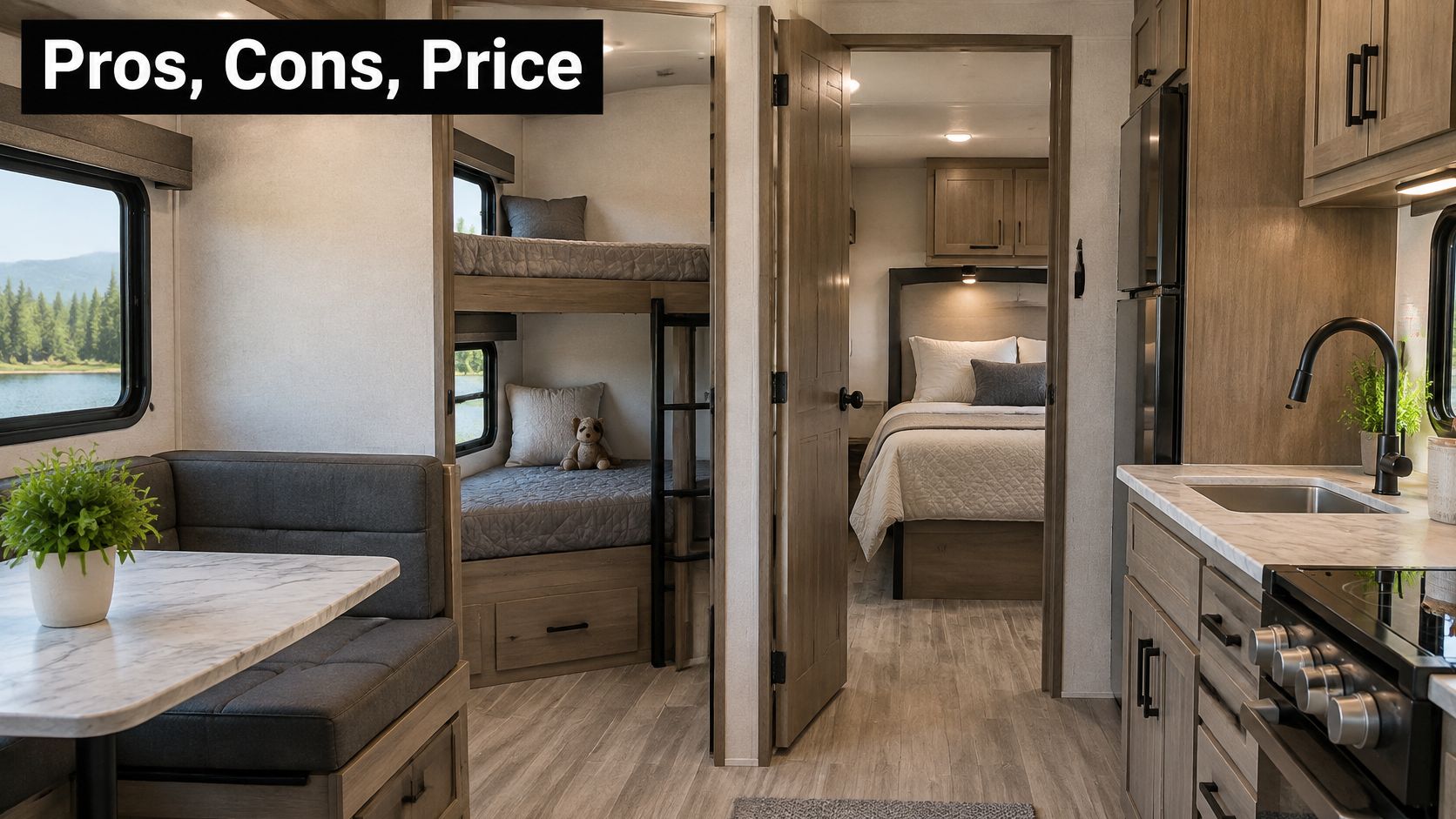
Look at the relationship between beds, dining space, and walkways when comparing interiors.
Benefits worth paying for
- Separate sleeping areas: Children and adults can follow different bedtime routines.
- A useful guest or office room: The right enclosed room supports more than sleeping.
- Fixed bunks: Bedding stays in place instead of becoming another evening chore.
- Shared accommodation: Your regular travel group can camp together in one trailer.
Costs beyond the purchase
- More trailer to manage: Added body length and loaded mass affect towing and parking.
- More upkeep: Extra interior space needs cleaning, inspection, winter preparation, and storage.
- Less lounge space at bedtime: Convertible beds can displace seating and block walkways.
- A narrower shopping shortlist: Requiring a particular private-room configuration can limit used choices within your budget.
Rank bunk configuration, bathroom access from both sleeping areas, fresh and waste tank capacity, GVWR, hitch requirements, air conditioning, and interior storage before comparing decorative finishes. Our broader guide to the pros and cons of travel trailers can help you weigh the towable format itself.
For a price benchmark, Campers Inn listed a used 2024 Forest River Rockwood Signature 8338 at $45,487 in 2026, identifying two bedrooms and sleeping capacity for 8. Dividing that asking price by its listed capacity produces approximately $5,686 per sleeper, before towing, insurance, and storage.
That's one used listing, not a market price range or a guarantee of current availability. Condition, equipment, water-intrusion history, and maintenance records matter more than a tidy cost-per-sleeper calculation.
Budget separately for Salt Lake City winter storage if you can't keep the trailer at home. Compare the full ownership cost, including any tow-vehicle upgrade, rather than treating the sticker price as the complete purchase decision.
Choose Your Two-Bedroom Trailer with Motor Sportsland
A trailer can sleep four and still feel cramped during the day. Before choosing a floorplan, check how beds, seating, and walkways work in both modes.
Start by comparing current inventory online, including listed lengths, weights, floorplans, and features. Then visit a Motor Sportsland location and ask to see the beds set up for sleeping. Bring a checklist and tape measure.
- Browse current inventory. Use the Motor Sportsland website to compare listed lengths, weights, floorplans, and features.
- Check the layout in both modes. Ask to see each bed deployed, then check seating, walkways, and access to the bathroom and kitchen. Customers can be shown around any trailer they want to see.
- Bring vehicle information. Bring photos of your tow vehicle's door-jamb rating labels, plus details about passengers and the cargo you plan to carry. Compare the trailer's listed weights with your vehicle's ratings and account for your planned load.
- Discuss how you travel. Tell the team which campgrounds and mountain routes you use, where you'll store the trailer, and who normally travels. Those details can help narrow the choice between more sleeping separation and easier day-to-day use.
For a bunkhouse alternative, the 2026 Keystone Walkabout 22MAX has convertible bunks and a dedicated kids' play nook. It sleeps 4, measures 26 feet 7 inches, has a 6,365-pound dry weight, an 8,600-pound GVWR, and 1 slideout. The 2027 Keystone Walkabout 25MAX has a king-size bed in its private master suite, theater seating, and a sofa. Compare the layouts in daytime and sleeping configurations; neither bed count nor a private master suite alone guarantees two separate bedrooms.
Use this video alongside your shopping checklist.
The right choice balances usable sleeping space with the trailer's size and weight. Check both before committing.
Two-Bedroom Travel Trailer FAQ
Does a two-bedroom travel trailer have two private bedrooms?
Not necessarily. Many listings describe a bunkhouse, a separated sleeping area, or a bedroom plus convertible lounge furniture. Check actual walls, doors, bed dimensions, and access with the beds deployed.
What tongue weight should I aim for?
Use your tow-vehicle, trailer, and hitch manufacturers' guidance, with the conventional-trailer planning range shown in the towing table as a starting point. Confirm the actual hitch load with the trailer packed for travel, not empty on the lot.
How do I know whether a Utah campsite will fit?
Compare the trailer's overall length with the site's stated equipment allowance. Add the hitch section only if it isn't already included in the published measurement, and confirm tow-vehicle parking, slide clearance, and turning access.
Is a tow rating enough to pull a heavy family trailer?
No. You also need adequate payload, axle capacity, hitch capacity, and compliant loaded vehicle and trailer weights. Include the family and gear in the calculation, not just the trailer.
Is a used two-bedroom trailer a good deal?
It can be, provided condition and total ownership costs support the asking price. Inspect the roof, sealants, slide floors, plumbing, appliances, and maintenance history, then compare towing and storage costs rather than relying on sleeping capacity alone.
Motor Sportsland can help you compare travel trailers with two bedrooms against bunkhouse and convertible layouts, with a walkthrough focused on usable space. Visit Motor Sportsland to start your shortlist, then bring your tow-vehicle ratings and camping plans to our Salt Lake City-area team for a practical comparison.
